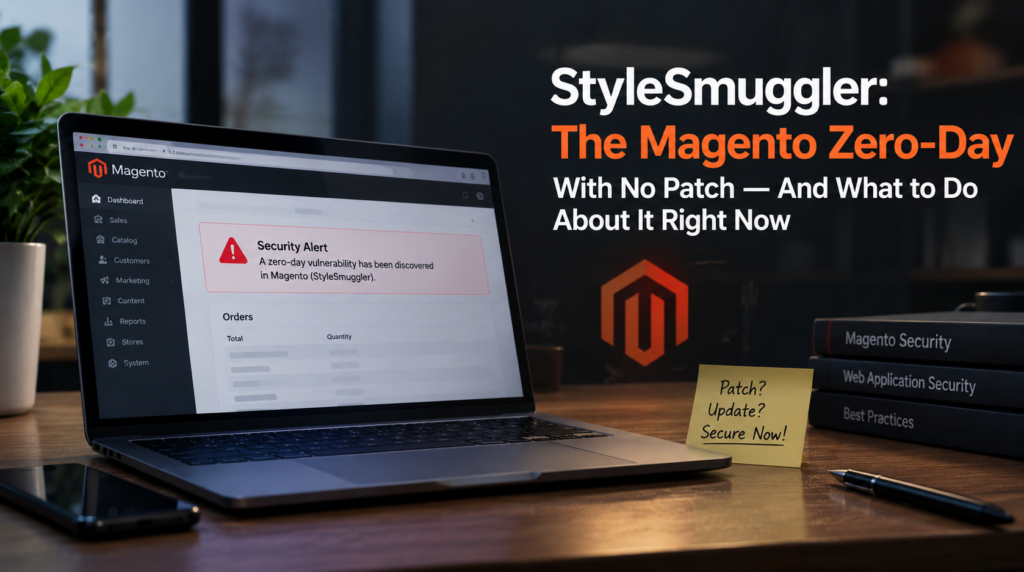
What Is StyleSmuggler?
On Friday, September 5, 2026, e-commerce security firm Sansec — the team behind the CosmicSting and SessionReaper research — published an early advisory about a previously unknown vulnerability chain they named StyleSmuggler. They published before completing their full technical analysis for one reason: stores were actively being compromised while they were still investigating.
The first confirmed attack was traced to September 4 at 22:20 UTC. That means this was exploited in the wild as a true zero-day: attackers were using it before anyone outside their circle knew it existed.
StyleSmuggler allows an unauthenticated attacker to execute code on your store’s server. Once inside, attackers are not simply skimming data and leaving — they are installing persistent backdoors that survive reboots and give them ongoing access to the environment.
Why This One Is Different: “Fully Patched” Doesn’t Mean Safe
Most Magento security incidents follow a familiar script: a patch exists, some merchants delay applying it, and the laggards get hit. StyleSmuggler breaks that script.
The first confirmed victim identified by Sansec was running Magento Open Source 2.4.6-p15 with the July and August 2026 security patches fully applied. Its security:patch-status check came back clean. By every standard measure a merchant is told to run, that store was up to date — and it was compromised anyway.
There is currently no patch to apply. Being current protects you from last month’s threats, not this one. That’s why active mitigation, not patching, is the correct response this week.
How the Attack Works (High Level)
We are deliberately keeping this at a conceptual level — enough for you to understand your exposure, not enough to serve as an exploitation guide.
The attack chain unfolds in two stages, abusing Magento’s own legitimate systems rather than a single obvious injection point:
- Stage 1 — Injection: The attacker plants malicious PHP code inside Magento’s template rendering system. The technique abuses style properties in templates — hence the name — which allows the payload to slip past the template safeguards Magento already has in place. Researchers have linked the entry path to the GraphQL layer, the API that powers headless and PWA storefronts.
- Stage 2 — Execution: The attacker then deliberately triggers one of Magento’s standard transactional emails — the “Payment Transaction Failed Reminder” — which causes the poisoned template to render and the injected code to run on the server.
The result is code execution as the web application user, followed by installation of a persistent backdoor. Observed backdoors disguise their processes under innocuous system-sounding names such as kworker and gvfsd-user to blend in with legitimate Linux processes.
How to Check Whether Your Store Has Been Compromised
Before mitigating, check whether you’re already a victim. Warning signs and indicators of compromise (IoCs) observed so far:
Behavioral indicators:
- Unexpected bursts of “Payment Transaction Failed Reminder” emails. This exploit deliberately fires that email. If your store sent a cluster of these that don’t correspond to real failed payments, treat it as a red flag and investigate immediately.
- Unfamiliar processes running under your web/PHP user, particularly ones named
kworkerorgvfsd-user. Genuinekworkerprocesses belong to the kernel and run as root — akworkerowned bywww-dataor your PHP-FPM user is not normal. - Recently modified or newly created PHP files in your Magento installation, especially in
pub/,var/,generated/, or media directories. - Unexpected admin users, API integrations, or cron entries.
Network indicators (defanged — do not visit these):
247.cdnflare[.]xyz— malware distribution209.141.43[.]95— malware distribution99.84.67[.]186:443— command & controlwindwsecurity[.]run:443— remote shellntp.timesync[.]to:123— command & control disguised as NTP traffic
Check your outbound firewall logs and DNS logs for connections to any of the above. Also review your web server access logs for unusual GraphQL requests around and after September 4.
Scanning: Sansec’s eComscan is currently the only scanner confirmed to detect this backdoor. Standard malware scanners were not detecting it at the time of disclosure. A “clean” result from a generic scanner is not conclusive.
The Solution: What to Do Right Now (No Official Patch Required)
There is no official fix yet, but you are not helpless. Here is the mitigation plan we deployed across every store under Czargroup management this weekend — and the same plan we recommend to any Magento or Adobe Commerce merchant.
Step 1 — Restrict or Disable GraphQL (Highest Impact)
The attack path runs through Magento’s GraphQL endpoint. If your storefront does not depend on GraphQL — which is the case for most standard Luma-based themes — blocking it removes the known attack surface with zero customer impact.
At the web server level (Nginx example):
location /graphql {
    return 403;
}
Apache (.htaccess or vhost):
<LocationMatch "^/graphql">
    Require all denied
</LocationMatch>
Before you block: check your access logs. If you see legitimate GraphQL traffic — from a PWA Studio storefront, a headless frontend, a mobile app, or third-party integrations — a blanket block will take those offline. In that case:
- Restrict
/graphqlto known IP ranges (your frontend servers, integration partners) instead of blocking it outright, or - Apply WAF filtering (Step 2) rather than a full block.
Step 2 — Put a WAF in Front of the Store
If you’re behind Cloudflare, Fastly (Adobe Commerce Cloud), or a similar edge, add rules to:
- Rate-limit and challenge requests to
/graphql - Block requests with suspicious payload patterns targeting template/style properties
- Geo-restrict or challenge traffic from networks with no legitimate business reason to hit your APIs
Sansec’s own Shield product ships virtual-patching rules for this attack and is a reasonable stopgap for merchants without in-house security resources.
Step 3 — Scan for Existing Compromise
Mitigation only helps if the attacker isn’t already inside. Run a scan after applying Steps 1–2:
- Run eComscan (the only tool confirmed to detect this specific backdoor at time of writing)
- Diff your codebase against a known-good copy from version control (
git status/git diffon the server should show no unexplained changes) - Audit admin users, integration tokens, and crontab entries
- Review file modification times across the docroot since September 3
Step 4 — Harden the Blast Radius
Assume the worst and reduce what an attacker could reach:
- Rotate admin passwords, API keys, and integration tokens
- Verify database and payment credentials aren’t stored anywhere world-readable
- Ensure your web user cannot write to code directories (
pub/staticandvarexcepted per Magento’s recommended permissions) - Confirm off-server backups exist from before September 4 — you may need a known-clean restore point
Step 5 — Watch Your Transactional Email
Set an alert (or simply a daily manual check) on outbound “Payment Transaction Failed Reminder” volume. It’s an unusual situation where a marketing email report doubles as a security tripwire — use it.
Step 6 — Be Ready to Patch the Moment Adobe Ships
Adobe’s next scheduled security release is September 8, 2026. It is not yet confirmed whether it addresses StyleSmuggler, but when the official fix lands — whether tomorrow or out-of-band — it should be applied immediately, not on your normal maintenance cycle. History is instructive here: after previous disclosures like CosmicSting and SessionReaper, mass exploitation waves hit unpatched stores within days.
Subscribe to Adobe’s security bulletin feed and Sansec’s advisory page so you hear about the fix the hour it’s released.
If You Confirm a Compromise
- Isolate the environment (maintenance mode + firewall) — don’t just delete the malware and move on; backdoors are persistent by design.
- Preserve logs and a disk snapshot for forensics before cleaning.
- Restore from a known-clean backup predating September 4, then apply all mitigations above before going live.
- Rotate every credential the environment had access to.
- Assess your notification obligations — if card data or customer PII may have been exposed, PCI DSS and privacy regulations (GDPR, etc.) may require disclosure. Speak to your QSA or legal counsel.
What Czargroup Did for Our Clients
When Sansec’s advisory went live on Friday evening, our team began emergency response and worked through the weekend. By Sunday, September 7, every Magento and Adobe Commerce store under Czargroup management had:
- Emergency mitigations deployed, tailored to each store’s architecture (full GraphQL blocks where safe; targeted restrictions and WAF filtering for headless/PWA builds)
- A compromise scan completed, including checks against all published indicators
- Monitoring in place for the email-based tripwire and anomalous outbound traffic
- A standing plan to apply Adobe’s official patch the moment it ships
No client action was required, and no storefront downtime was involved.
Need Help? We’re Here — Client or Not.
If you run a Magento or Adobe Commerce store and any part of this article raised your heart rate, don’t sit on it. Czargroup Technologies is offering rapid assistance during this incident:
- Emergency mitigation deployment (GraphQL restriction, WAF rules)
- Compromise assessment and scanning
- Incident response and clean recovery if your store has been hit
- Priority patching when Adobe’s official fix is released
📩 Contact us — mention “StyleSmuggler” and we’ll prioritize your request.
Sources & Further Reading
- Sansec — StyleSmuggler: Magento and Adobe Commerce 0-day RCE under active attack
- The Hacker News — Unpatched Magento and Adobe Commerce Zero-Day Exploited to Backdoor Online Stores
- Adobe — Security bulletin index (watch for the official advisory and patch)
This article will be updated as new information becomes available. Facts above are accurate to the best of our knowledge as of September 7, 2026.
FAQ's
Frequently Asked Questions
No. StyleSmuggler is specific to Magento Open Source and Adobe Commerce. Merchants on other platforms are unaffected by this particular vulnerability.