Your store is slow. Your theme fights every design decision. Checkout can’t be touched. Sound familiar? Headless commerce promises to fix all of that — but it’s not right for everyone. Here’s the honest answer.
$11.8B
Headless market value by 2028
64%
Enterprises already using headless architecture
30%
Faster checkout reported with headless Shopify
62%
Companies say headless improves conversions
What Is Headless Commerce?
If you’ve been running an online store for a while, you’ve probably hit the wall at some point. You want to redesign a page, but the theme won’t let you. You want a custom checkout flow, but the platform locks it down. You want your store to load in under two seconds, but the bloated template is pulling it down to four.
This is the problem headless commerce was built to solve.
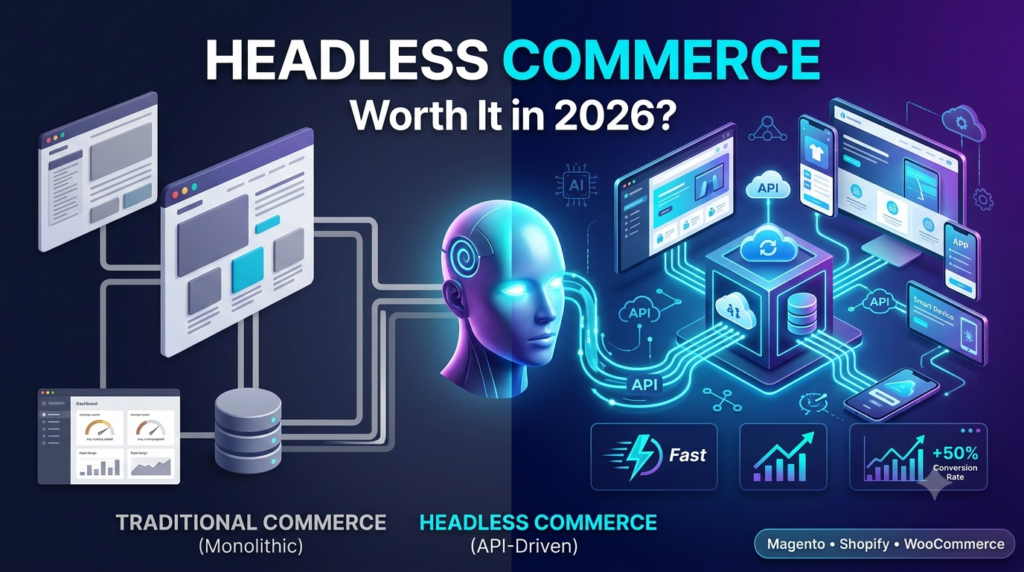
In a traditional ecommerce setup — whether that’s Magento, Shopify, or WooCommerce — the frontend (what your customers see and click) and the backend (your products, orders, inventory, and data) are bundled together in one system. They’re tightly coupled. When one moves, the other moves with it. That’s convenient when you’re starting out, but it becomes a serious constraint as you grow.
Headless commerce decouples them. The backend stays on your chosen platform — Magento, Shopify, BigCommerce, whatever makes sense — and the frontend is built entirely separately using modern frameworks like React.js, Vue.js, or Angular. The two talk to each other through APIs, passing data back and forth in real time.
Think of it this way: the backend is your engine — powerful, reliable, managing all your commerce logic. The frontend is the car body — the part your customers see and interact with. Headless lets you design and build any car body you want, without touching the engine underneath.
TRADITIONAL COMMERCE
HEADLESS COMMERCE
5 Real Benefits of Going Headless in 2026
The reason headless is moving from early-adopter territory into mainstream ecommerce in 2026 isn’t hype — it delivers measurable results across five areas that matter directly to your bottom line.
1. Dramatically faster storefronts
Headless frontends are purpose-built for speed. Because the frontend is a separate, lean application rather than a bloated CMS theme loaded with unnecessary scripts, pages render faster. Shopify’s Hydrogen framework reduces build times by 50% compared to traditional Liquid themes. For context: a one-second delay in page load time can cost you a meaningful portion of conversions. Speed is not a nice-to-have; it’s revenue.
2. Total design and UX freedom
You’re no longer working around a theme’s constraints. Every pixel, every interaction, every animation is under your control. For brands where the shopping experience itself is part of the product — luxury goods, fashion, home interiors — this freedom pays for itself quickly. You can build checkout flows, product discovery experiences, and landing pages that no off-the-shelf theme could deliver.
3. True omnichannel selling
One backend, every channel. With headless, the same Magento or BigCommerce backend that powers your website also serves your mobile app, in-store kiosk, social commerce integrations (TikTok Shop, Instagram Shopping), and voice assistants — all via the same APIs. You manage products and orders once; they appear everywhere.
4. Stronger SEO performance
Faster load times, cleaner code, and better Core Web Vitals scores translate directly into improved Google rankings. Headless architectures also allow developers to build precisely the structured data and semantic HTML that search engines reward. Platforms like standard Magento and Shopify face SEO challenges from fixed structures and speed limitations; headless removes those ceilings.
5. Scalability that grows with you
Frontend and backend scale independently. You can deploy a major storefront redesign without touching the commerce backend. During traffic spikes — seasonal sales, product launches — the API layer absorbs demand without the frontend collapsing. About 64% of enterprise organisations now use headless architecture specifically for this scalability advantage.
- Pages load faster — directly improving conversion rates
- No design constraints — build exactly what your brand needs
- One backend powers web, mobile, in-store and social simultaneously
- Better Core Web Vitals = stronger Google search rankings
- Frontend and backend scale and deploy independently
The Honest Downsides — When Headless Isn't the Right Call
We’d be doing you a disservice if we only told you the upside. Headless commerce is a significant investment, and for some businesses it genuinely isn’t the right move — at least not right now.
Higher upfront cost.
A custom headless frontend takes significantly more development time and budget than choosing a pre-built theme. You're commissioning a bespoke frontend application, not customising a template.
You need specialist developers.
Headless requires both ecommerce platform expertise and modern frontend engineering (React, Vue, APIs). Not every development agency can do both well. Those that can — like CzarGroup — are in genuine demand.
Two systems to maintain.
Frontend and backend updates, security patches, and hosting are now two separate engineering concerns. Your ongoing costs and team complexity are higher.
Overkill for smaller stores.
A lean Shopify or WooCommerce store with a well-optimised theme, good hosting, and smart caching can deliver excellent performance at a fraction of the cost. Headless makes sense when you've outgrown what standard platforms can give you.
A note on trust
We only recommend headless when it genuinely fits. If your store is early-stage or your catalogue is straightforward, we’ll tell you — and point you to a Magento or Shopify solution that delivers results at the right cost. Our 90% client retention rate is built on honest advice, not overselling.
Headless on Magento, Shopify & BigCommerce — How It Works
The good news: all three major platforms CzarGroup works on have mature headless capabilities in 2026. Here’s how they differ in practice.
| Platform | Headless Approach | Best For | Key Tech |
|---|---|---|---|
| Magento / Adobe Commerce | GraphQL APIs + PWA Studio; deep codebase access; full customisation | Complex B2B, enterprise, high-volume stores with many integrations | GraphQL, React, Vue, Adobe Experience Manager |
| Shopify Plus | Hydrogen + Oxygen framework; React-based frontend; Storefront API | D2C brands scaling fast; merchants wanting quickest headless on-ramp | Hydrogen, React, Next.js, Oxygen hosting |
| BigCommerce | Open API architecture; headless-friendly natively; strong multi-channel | Mid-market brands needing flexibility without full backend decomposition | REST & GraphQL APIs, React, Vue, Angular |
At CzarGroup, our headless ecommerce development practice covers all three platforms. Our frontend teams work in React.js, Vue.js, and Angular — paired with whichever backend architecture makes the most commercial sense for your business. We don’t have a preferred platform; we have a preferred outcome: a store that performs.
Is Headless Right for YOUR Store? A Practical Decision Framework
This is the question the headline promised to answer, so here it is directly. Run through both columns below honestly.
You likely need headless if…
Your store handles high traffic and conversion speed is critical
You sell across multiple channels — web, app, social, in-store
Your UX requirements are too complex for any theme to deliver
You’re B2B with custom pricing, configurators, or portal features
You’re planning serious international expansion
Your current platform is actively limiting your growth
You probably don't need headless yet if…
You’re an early-stage store still finding product-market fit
Your catalogue is small and your UX needs are straightforward
Your development budget is under £30k
You don’t have — or can’t hire — specialist frontend developers
A well-optimised standard theme already delivers good performance
You’re not yet selling across multiple channels
There’s also a middle path worth knowing about: headless-on-platform. A Shopify Plus store with a custom Next.js frontend, or a Magento backend with a Vue.js storefront, gives you frontend independence without the full complexity and cost of a composable architecture. For many mid-market stores, this is exactly the right answer.
What Brands Are Actually Achieving With Headless
The market research is compelling, but real-world outcomes are what matter. Across headless implementations on Shopify Plus, Magento, and BigCommerce:
- Stores adopting Shopify’s Hydrogen framework report 30% faster checkout times and significantly improved mobile conversion rates
- Enterprises using headless architecture report improved scalability during peak traffic — handling Black Friday spikes without platform slowdowns
- Brands moving to headless regularly report better Core Web Vitals scores within weeks of launch, with corresponding improvements in organic search rankings
- Omnichannel retailers using a single headless backend to serve web, mobile, and in-store channels report meaningful reductions in operational complexity and product management overhead
CzarGroup has been building headless solutions since the architecture became viable at the mid-market level. Our work spans custom Magento GraphQL implementations, Shopify Hydrogen storefronts, and Vue.js frontends on BigCommerce. If you’d like to discuss a specific challenge — whether you’re considering a migration, a replatform, or a first headless build — our team is straightforward about what’s achievable at your budget and timeline.
So, Is Headless Commerce Worth It in 2026?
The answer is: yes, for the right businesses — and definitely not for everyone.
Headless commerce in 2026 is no longer an early-adopter technology reserved for enterprise brands with seven-figure development budgets. The tooling has matured. Shopify’s Hydrogen, Magento’s GraphQL APIs, and BigCommerce’s open architecture have all lowered the barrier to entry significantly. The headless market is on track to reach $11.8 billion by 2028 for a reason: it delivers.
But the stores winning with headless are ones that genuinely needed what it offers — speed, design freedom, omnichannel scale, and complex UX — and had the development partnership and ongoing operational model to run it well.
If your store is in that bracket, the question isn’t really whether to go headless. It’s who you build with, and whether they understand both the commerce logic and the frontend engineering at the same depth.
If you’re not sure which camp you’re in, that’s exactly the conversation worth having.
Not sure if headless is right for your store?
CzarGroup has built headless solutions on Magento, Shopify and BigCommerce for 15+ years. We’ll give you a direct answer — not a pitch. Book a free 30-minute consultation with our team.
FAQ's
Frequently Asked Questions
Headless commerce separates the frontend of your online store — what customers see and interact with — from the backend, which handles your product catalogue, orders, and data. The two parts communicate through APIs, giving you complete freedom to build any storefront experience without being constrained by a platform's built-in theme system.
For most small stores with a straightforward product catalogue and a limited development budget, a well-optimised standard Magento or Shopify theme will genuinely outperform the cost of going headless. Headless delivers its strongest ROI for stores with high traffic, complex UX requirements, multi-channel selling needs, or B2B workflows. If you're not sure which camp you're in, we're happy to give you a straight answer.
All major platforms support headless well in 2026. Magento (Adobe Commerce) provides GraphQL APIs and PWA Studio for enterprise-grade headless builds. Shopify offers the Hydrogen and Oxygen frameworks for React-based frontends. BigCommerce has open API architecture that is headless-friendly natively. CzarGroup builds headless solutions on all three, pairing them with React.js, Vue.js, or Angular on the frontend depending on your requirements.
Headless commerce decouples the frontend from the backend. Composable commerce takes this further — it also decomposes the backend into independent, best-of-breed services for search, checkout, CMS, personalisation, and so on, all connected via APIs under a MACH architecture (Microservices, API-first, Cloud-native, Headless). Every composable architecture is headless, but not every headless implementation is composable. For most mid-market stores, headless-on-platform is the right answer; full composable is for enterprises with genuine complexity at scale.
A headless implementation typically takes longer than a standard theme-based build — usually three to six months depending on complexity, the number of integrations required, and the scope of the custom frontend. That said, once a headless store is live, it is significantly faster to iterate on, because frontend and backend updates deploy independently without the risk of breaking the other system.